

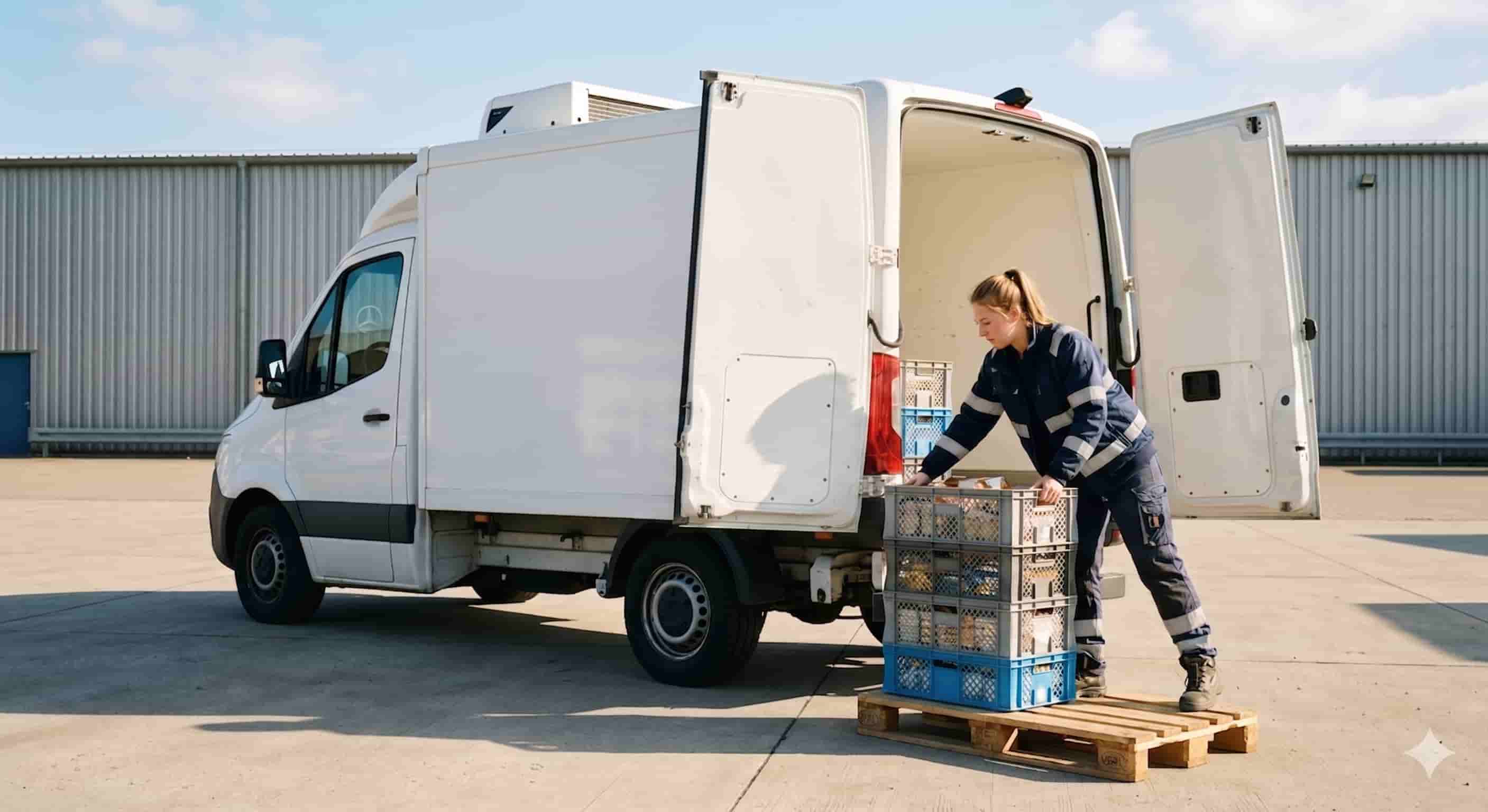
You need a refrigerated vehicle – a refrigerated van or refrigerated truck – and want to know what it costs, what really makes sense, and what mistakes other businesses in your situation have made. This guide covers all the options: buying new, buying used, hiring, leasing or financing – with prices, rules of thumb, and practical decision guides for bakeries, restaurants, caterers, pharmacies and food delivery businesses.
Refrigerated Van: Types, Sizes and Brands Overview
What sizes are there – and which do I need?
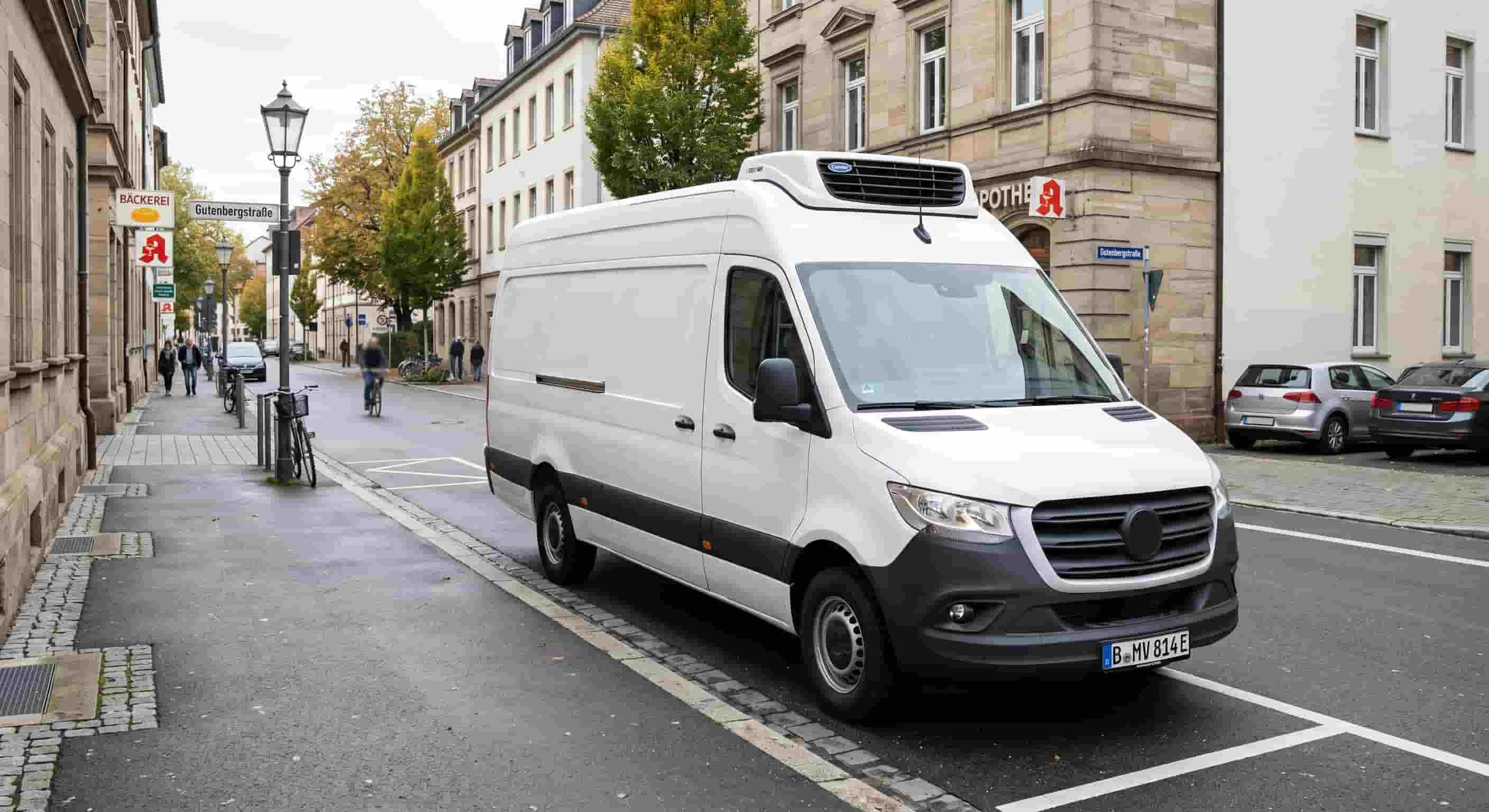
Broadly, we distinguish three classes:
Refrigerated vans up to 3.5t
The standard for daily delivery in towns and surrounding areas. Classic choice for bakeries with their own delivery rounds, smaller caterers, butchers with home delivery, pharmacy couriers or farm shops with box schemes. A standard Category B licence is sufficient.
Refrigerated trucks from 7.5t
For longer routes with multiple stops, larger quantities or multi-temperature setups, where you carry chilled and frozen goods simultaneously. An HGV licence is required, and a dedicated driver is usually more economical than the owner doing it themselves.
Refrigerated trailers from 12t payload
For long-distance haulage and large logistics operations, less common in the SME sector, more the standard for wholesale and logistics businesses.
Electric refrigerated vans are becoming increasingly relevant. Several manufacturers offer complete solutions, from Mercedes (eSprinter with Thermo King E-200 unit) to retrofitted variants like the eCrafter or eDucato. Range depends heavily on the refrigeration load, which is why electric models work best on short urban routes with fixed charging stops. The hidden practical pitfall is weight: battery and body eat into the 3.5t payload almost entirely, which is why models with a 4.25t special Category B licence are usually essential. After recent government subsidy cuts, you should no longer count on BALM grants in your budget planning.
More important than size is often the temperature class: chilled goods such as cheese, cold meats, meat, fish and dairy are transported between +2 and +8°C. Frozen goods such as ice cream or frozen vegetables need at least −18°C, often colder. Frozen goods units are technically more complex and significantly more expensive.
Choosing the right refrigeration unit, bodybuilder and base vehicle
A refrigerated van consists of three components: base vehicle, body and refrigeration unit. What we often see: buyers spend a long time choosing the vehicle model – and barely think about the other two. Economically, the order should often be exactly the other way round.
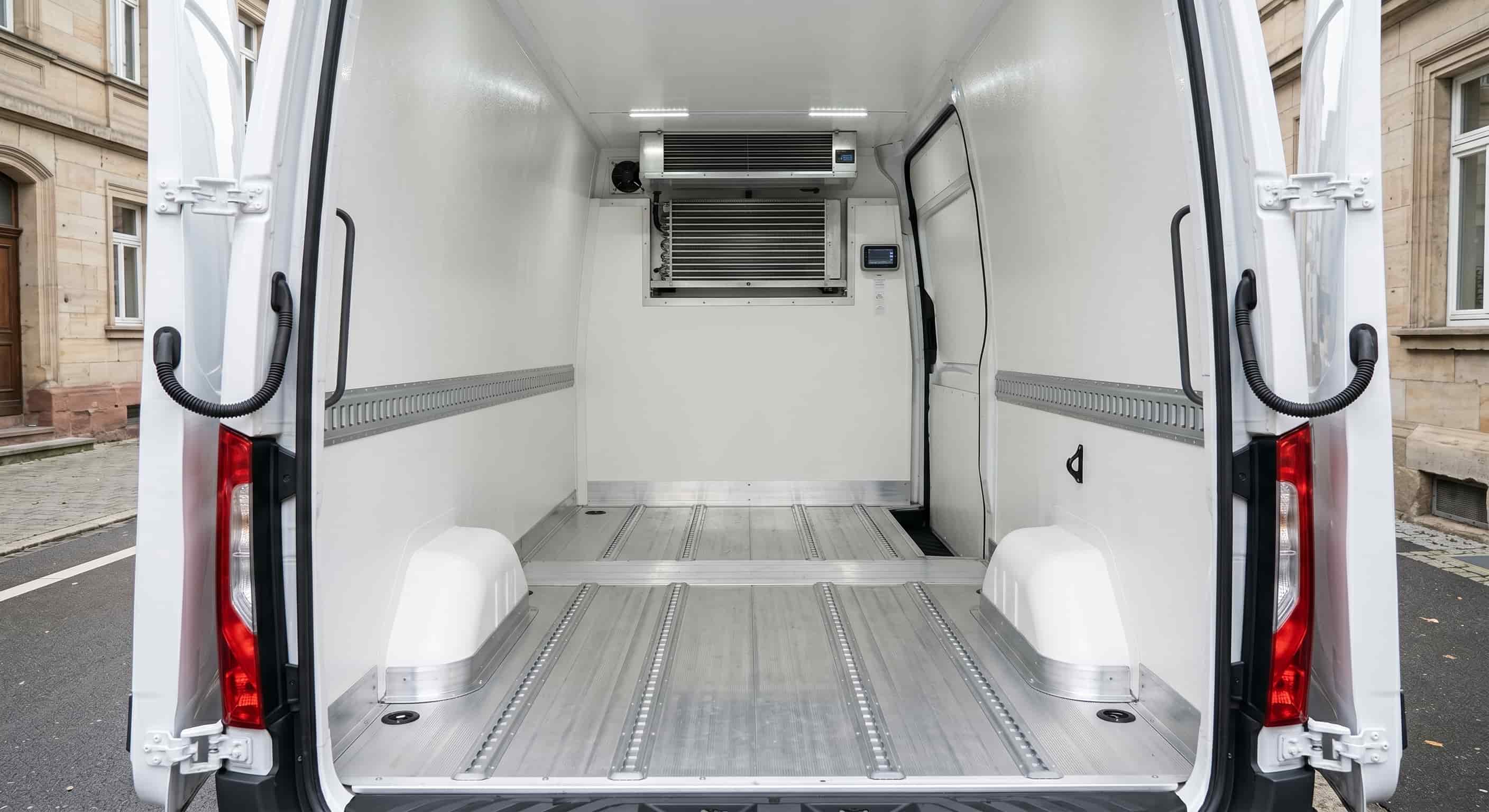
The refrigeration unit – the most critical choice
The refrigeration unit is not the most expensive component, but the most important decision. It often runs longer each day than the engine – including when stationary at a loading bay. If it fails in summer, your goods are lost within hours. Replacement costs €5,000 to €15,000, and refrigeration engineers are far scarcer than regular mechanics.
Two manufacturers dominate the European market: Carrier Transicold with the Xarios range (Xarios 200 for small vans, 300 for standard 3.5-tonners, 350 for larger multi-temperature setups) and Thermo King with the V-series (V-200 to V-500 by vehicle size). Both have dense service networks in Germany – Carrier with over 900 service points worldwide, Thermo King with over 500. Also relevant: Frigoblock (part of Thermo King) for hybrid drives and Kerstner, one of the few manufacturers offering unit and body from a single source.
We always recommend: Before buying, check whether there is a 24-hour breakdown service partner in your area. With Carrier and Thermo King this is part of the standard service package; with smaller brands it depends on the local partner.
The body – determines the lifespan
This is where it’s decided whether the vehicle will still be ATP-compliant after ten years and how much energy the refrigeration unit needs to maintain temperature. Leading in Germany: Kress Fahrzeugbau (around 700 refrigerated vehicles per year, DUROLITE sandwich construction for higher payload, pharmaceutical version GDP-certified), Kerstner-Lamberet (unit and body from a single source – one workshop visit instead of two), Winter Fahrzeugtechnik and Kiesling.
Unlike the refrigeration unit, this is less about emergency call-outs and more about planned maintenance – ATP repeat inspections, seals, minor body repairs. A bodybuilder with a local workshop saves many hours over ten years.
The base vehicle – usually the easiest decision
Sprinter, Daily, Crafter, Transit, Ducato – all solid, all supported by every bodybuilder. Choice comes down to personal preference, the local workshop network or existing fleet standardisation.
Once the decision to buy has been made, the next question is pricing.
Buying a Refrigerated Van New: Prices
A base vehicle without refrigeration – a standard Sprinter, Daily, Crafter, Transit or Ducato – starts at around €35,000 to €50,000 net when new. The refrigerated body adds typically between €8,000 and €25,000 extra depending on complexity.
What you end up paying for a ready-to-use vehicle:
A ready-to-use 3.5t refrigerated van new typically means budgeting €45,000 to €80,000 net – depending on temperature class and specification.
What drives the price up – and when it’s worth it:
- Tail lift (€3,500–5,000): Practically essential if you move pallets or regularly handle items over 30kg. If you only load crates, it’s optional.
- Frozen goods unit instead of standard chilled setup (€3,000–6,000 premium): Only needed if you regularly transport below −18°C – ice cream, frozen veg, frozen meat.
- Partition wall for dual-temperature operation (€2,000–4,000): Useful if you carry chilled and frozen goods on the same run – typical for full-range suppliers and larger caterers.
- Telematics with temperature logger (€1,500–3,500 plus monthly fee): Mandatory for GDP pharmaceutical transport. Not formally required everywhere for food, but many supermarket chains require continuous temperature documentation as a supplier condition.
- Standby cooling with mains connection (€2,000–4,000): Worth it if the van is loaded in the evening and parked overnight – saves burning diesel for refrigeration.
Alternative: Retrofitting a refrigerated van
If you already own a standard van, you can retrofit with a mobile refrigeration box (such as VebaBox) for around €5,000 to €10,000. Cheaper but technically limited – for regular food transport with ATP requirements, a proper refrigerated body is the cleaner solution.
If the new vehicle price puts you off, the used market offers a more economical solution for many businesses.
Used Refrigerated Van: Prices & Tips
A used 3.5t van costs between €15,000 and €50,000 depending on age and condition; newer models from 2020 typically fetch €30,000 to €45,000.
The used market is large: TruckScout24, mobile.de, Truck1, Autoline and classifieds always have hundreds of listings. A Sprinter typically holds 65 to 90% of its new price after three years, around 55% after six years, and between 30 and 45% after ten years. With patience, real bargains exist.
On several points, a close look pays dividends when buying used:
- Operating hours on the refrigeration unit – not just the mileage. With a typical 8 hours of refrigeration per day, a unit accumulates around 2,000 hours per year. Rule of thumb: under 5,000 hours is good; over 10,000 hours means budgeting for replacement.
- Service history and last inspection – complete and traceable.
- Valid ATP certificate – confirms the unit can hold the required interior temperature at +30°C outside. More in the FAQ.
- Functional test in warm weather – does the unit still reach target temperature in summer?
- Condition of the insulation – dents in the body, seals, floor tray.
- Refrigerant type – older refrigerants like R404A are being phased out under the F-Gas Regulation and conversion can be costly.
For irregular demand, it’s worth considering hiring before you buy – usually cheaper and always more flexible.
Refrigerated Van or Truck Hire: Costs
If you only need a refrigerated van occasionally, hiring is often the better option. This is the case for many bakeries, butchers or caterers with seasonal demand. Daily rates fall in the following range:
- 3.5t refrigerated van: around €40 to €90 per day
- 7.5t refrigerated truck: €120 to €250 per day
- Monthly hire: depending on model, between €800 and €2,100
Daily hire typically includes insurance, maintenance, a service hotline and a replacement vehicle if yours breaks down. You pay extra for excess mileage, end-of-hire cleaning and special equipment such as frozen goods, multi-temperature or telematics.
Hiring a refrigerated vehicle makes most sense in four situations:
- Seasonal peaks – bakery before Christmas, caterer during wedding season, ice cream producer in summer
- Testing a new route – does the new delivery run really pay off long term?
- Trade fairs and larger events as caterer or food supplier
- Short-term breakdown of your own vehicle
The largest hire companies with national coverage are Frigorent, Mercedes dealers with commercial hire fleets, and national comparison platforms for commercial vehicles. With long-term hire beyond six months, the bill quickly becomes more expensive than owning.
If you rely on the vehicle regularly, it’s worth running the numbers on whether owning makes more sense.
{{cta-newsletter}}
Hire vs. Buy – when does owning your own vehicle pay off?
Hiring is flexible – but with sustained demand it gets expensive. At a certain point you’re paying more for the same usage than if you bought or leased, without ever becoming the owner.
To make this concrete: a simplified daily cost calculation for a 3.5t refrigerated van (assumptions: vehicle price €55,000, 7 years use, approx. 15–20% residual value, 5% interest rate p.a., standard maintenance and insurance costs):
- Own vehicle (purchase or lease): around €30 to €40 per day, calculated over the useful life including maintenance, insurance and ATP inspections, less residual value (depending on condition) at the end
- Daily hire rate: from approx. €65 per day with frequent use, including all running costs
Rule of thumb: Under 100 to 150 days per year, hiring is usually cheaper. From around 150 days, owning your own refrigerated van pays off significantly. This is not an exact calculation – the precise break-even depends on daily rate, model and business size.
Leasing and financing land at similar daily costs – the real difference lies not in price but in who owns the vehicle and what that means for your balance sheet and taxes.
If you want your own vehicle, the next question is: Lease or Finance?
Refrigerated Van Leasing: Costs
You pay a fixed monthly rate over a set term (typically 36 to 60 months) and use the refrigerated van – it doesn’t belong to you. At the end of the term you return it or buy it at the previously agreed residual value.
In practice: no large upfront payment, predictable monthly rate, and at the end you can switch straight to a newer model.
Typical monthly lease rates for a refrigerated van (indicative – exact rates vary, ask your bodybuilder or dealer):
Advantages:
- Lease rates are fully deductible as business expenses
- The vehicle doesn’t appear on your balance sheet – this reduces the liquidity burden and leaves your bank credit line untouched
- No residual value risk: if the market values the vehicle lower after 4 years, that’s the leasing company’s problem
- Always current technology at the end of the term
Disadvantages:
- No ownership – you build nothing up
- Excess mileage is charged at a premium – driving a lot quickly adds up
- Early exit from the contract is barely possible and expensive
- Grants (e.g. KfW) cannot be combined with leasing
Leasing works best if you want newer vehicles regularly, want to keep your balance sheet lean, and don’t want to build up ownership.
Financing a Refrigerated Van
You buy the vehicle and pay off the price plus interest in monthly instalments. The vehicle belongs to you from day one – you can modify it, sell it or continue using it at any time.
In practice: the monthly rate is usually slightly higher than with leasing (because you’re actually buying, not just using), but at the end you own a vehicle with a real resale value.
Advantages:
- Ownership immediately – full freedom to modify, no mileage limits
- KfW funding possible, e.g. via KfW Unternehmerkredit
- Tax depreciation – the refrigerated van is written off over its useful life, reducing your taxable profit year after year
- No restrictions, no contract terms, no return date – the vehicle is yours and you decide alone what happens with it
Disadvantages:
- Credit check required, possible deposit
- Vehicle appears on the balance sheet – temporarily increases liabilities
- Higher monthly rate than leasing on a short term
Financing works best if you want to use the refrigerated van for a long time, want to build up ownership and want to keep the residual value in the business.
Refrigerated Van: Lease or Finance – which fits your business?
The daily costs are similar – the difference lies elsewhere. Three questions that usually settle it:
Do you want to still own the vehicle in 5 years?
Yes → financing. No or doesn’t matter → leasing.
Do you drive a lot of kilometres?
Heavy drivers quickly hit excess mileage charges with leasing. Financing has no limit.
Is your balance sheet or credit line currently under pressure?
Leasing barely burdens either. Financing temporarily increases liabilities.
Both have tax implications – with leasing, rates are fully deductible; with financing it runs through depreciation. What’s better for your business depends on your legal structure and how you calculate profit. A quick conversation with your accountant is worthwhile here.
Banxware Sofortfinanzierung for Your Refrigerated Van
If you need to act fast – whether to bridge a short-term liquidity gap or because a major customer is demanding new routes – you need capital within days, not weeks. That’s exactly what the Banxware Sofortfinanzierung is built for.
The Sofortfinanzierung covers up to €250,000, fully digital, with payout within 24 hours of approval. No collateral, no security, free use of funds – so it can also be used for the body premium, parallel inventory purchases, the deposit on a lease, or ancillary costs such as telematics, livery or the first ATP inspection. Requirements: at least 6 months’ turnover history in a business account, registered in Germany, average monthly turnover of €1,250 or more.
For larger investments – such as a refrigerated truck beyond €250,000 – the HVB FlexFinanzierung with up to €5 million is available.
{{cta-checkmarks}}
Refrigerated Van – Summary
If you’re making a decision right now, it helps to clarify three things first: which type suits your needs – chilled or frozen, 3.5t or larger? How regularly will the vehicle be used? And how much liquidity do you want to tie up?
Under 100 days per year, there’s a strong case for hiring. From 150+ days, owning pays off significantly. If you want your own vehicle: leasing keeps the balance sheet lean and offers flexibility, financing builds ownership and allows funding access – costs are broadly similar.
The Banxware Sofortfinanzierung is the fast solution for the purchase route – digital, no collateral, payout in 24 hours. For larger investments beyond €250,000, the HVB FlexFinanzierung can help.
Sources:
ATP Agreement UNECE, version 1 June 2022.
TÜV SÜD ATP Testing Centre (n.d.). Classification of refrigerated vehicles.
DNV (n.d.). ATP classification for transport equipment.
Regulation (EC) No 852/2004 on food hygiene (HACCP).
DIN EN 12830. Temperature recording devices for transport, storage and distribution of chilled and frozen foods.
GDP Guidelines 2013/C 343/01. Good distribution practice for medicinal products.
Regulation (EU) No 517/2014 on fluorinated greenhouse gases (F-Gas Regulation).
Carrier Transicold (2023/2024). Service network and maintenance information, eurotransport.de and carrier.com.
Trane Technologies / Thermo King (2024). TKV acquisition and German service network, profi-werkstatt.net.
TRANSPORT-Zeitung. Best-of-9 test refrigeration units (operating hour data).
Kress Fahrzeugbau GmbH. Product information and company data, kress.eu.
Lamberet Group / Kerstner. Company information, lamberet.com.
FINN.com / Sixt / leasingtime.de. Excess mileage costs in commercial leasing, 2026.
LOGISTRA. Reporting on electric refrigerated vans.
checkandrent.com. Market data on hire rates and purchase prices for refrigerated vans, 2026.
mobile.de and TruckScout24. Refrigerated van market inventory, 2026.
12gebrauchtwagen.de. Depreciation data for the Mercedes Sprinter.