

You are looking for the right work van for your trade and want to know which model suits your line of work, what it costs and how best to pay for it. This guide delivers both: a brand-neutral comparison of the best vans for tradesmen with current prices for new and used vehicles – and clear guidance on choosing between buying, leasing and financing. By the end you will know which van fits your business and how to get it onto your yard without a liquidity squeeze.
Let us start where the decision really begins: with the question of what your trade actually needs.
Which van suits which trade?
There is no single best tradesman’s van – there is the right one for your trade. Which van suits depends on cargo space, payload and fit-out, and these requirements differ significantly from one trade to the next. This is exactly where it is decided whether a van works in everyday use or constantly hits its limits. The following recommendations give you a starting point for your trade.
Electricians and HVAC businesses (plumbing, heating, climate) carry a lot of tools and small parts – what matters is a good shelving system and a walkable cargo area, not maximum volume. Electricians do well with a compact panel van like the VW Caddy Cargo or Ford Transit Courier. HVAC businesses that also carry bulky material such as pipes and radiators need a little more interior height – a Ford Transit Custom or Mercedes-Benz Vito is the better fit.
Painters, decorators and finishing trades carry buckets, sheeting, ladders and covering material. What counts is a mid-size cargo area that is easy to clean – a robust floor and a low loading sill make daily work noticeably easier. A Transit Custom or comparable mid-size panel van works well here.
Joiners, carpenters and structural carpenters have to transport long workpieces, timber beams and board material – cargo length is the decisive factor. The long variants of the Sprinter or Crafter with load-through capability are often the only practical solution. Structural carpenters additionally need high payload and towing capacity, sometimes also all-wheel drive for sites off paved roads.
Roofers and landscaping businesses share the need for high payload and towing capacity – both transport heavy loads and frequently move machinery or material over rough terrain. Large panel vans like the Sprinter or Crafter as well as robust vehicles as flatbeds or tippers are the right choice. As a site vehicle in tough use, function clearly comes before comfort.
These recommendations narrow down the choice. How the models actually differ in cargo space, payload and price is shown by the direct comparison.
The best work vans compared: from small van to large panel van
The established models are technically close together – the differences are in the detail of cargo space, payload and entry price. The following overview shows the most important panel vans compared, that is the models most commonly used in the trades, with verified net entry prices.
The prices are net entry prices for orientation (as of 2026) and rise considerably with equipment, length, drivetrain and body – there is barely an upper limit. On average, real sale prices are often several thousand euros below the list price thanks to trade discounts. You should obtain concrete quotes from a dealer, as list prices and trade promotions change constantly.
Above all the figures show one thing: the ranges are huge even within a single model line. The VW Crafter ranges from the compact 9.9 m³ panel van to the 18.4 m³ large-volume van. What matters is that you consider cargo space and payload together – a large volume with too little payload is of no use in everyday work if you transport heavy loads.
Which is the best work van for tradesmen?
There is no blanket test winner, but for the three typical needs profiles clear recommendations can be derived – based on professional tests and practical experience from the trades.
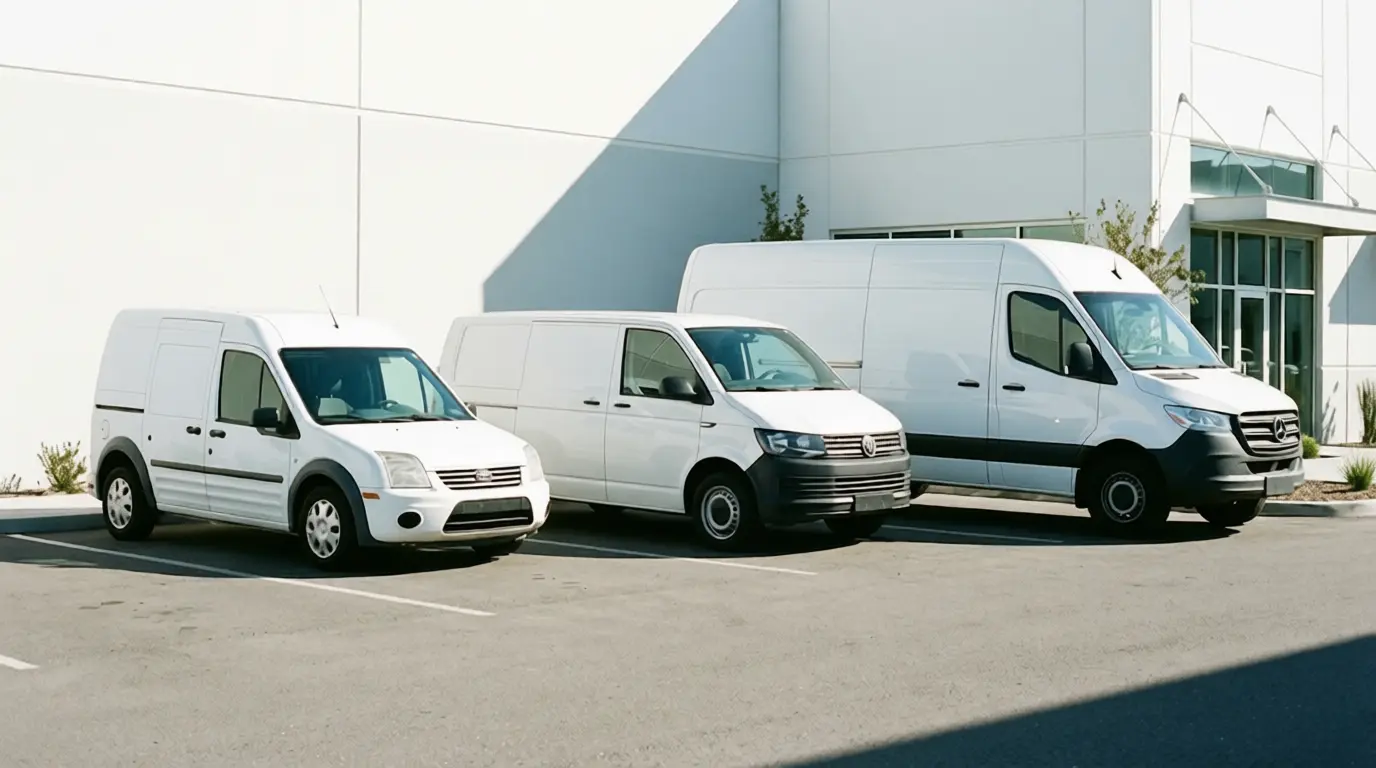
For little volume and a lot of city traffic (electricians, service businesses): the Ford Transit Courier is rated in professional tests as the best small van for many tradesmen – compact, nimble and comparatively affordable as a city delivery van with above-average payload for its class – the criticism being the instruments take getting used to. Alternatively, the VW Caddy Cargo is the established classic with many practical storage spaces in the driver area.
For the mid-size class (HVAC, painters, mixed use): the Ford Transit Custom is currently regarded as the technical benchmark of the one-tonne class – so convincing that VW sources the basis of its new Transporter from Ford. It offers the broadest drivetrain range, from diesel to fully electric. The Mercedes-Benz Vito is the robust, value-stable alternative.
For large and heavy loads (roofers, joiners, structural carpenters): the Mercedes-Benz Sprinter is the benchmark in the 3.5-tonne segment, valued for reliability, fit-out variety and a particularly dense service network – an advantage when a breakdown needs to be fixed quickly. The VW Crafter sits solidly mid-field in purchase and running costs and is considered easy to budget for. The Fiat Ducato is the most affordable option with the highest payload in the comparison and can often be repaired cheaply at independent garages too. Worth knowing: the Ducato is identical in construction to the Citroën Jumper, Peugeot Boxer, Opel Movano and Toyota Proace Max – these models share the same platform and differ mainly in price, equipment and dealer network. If you are flexible on the brand, this is where comparing the concrete offers pays off.
One more point that many tradesmen weigh up: what about going electric?
Electric van for tradesmen: is it worth it?
Electric vans like the Ford E-Transit, the e-Crafter or the eSprinter pay off above all for fixed, short routes in city traffic: free entry into low-emission zones, no vehicle tax in the first years and lower energy costs on short distances. Arguing against the switch are the higher purchase price and the lower range when fully loaded. Important for tradesmen: the battery has weight, and that weight comes off the payload – anyone transporting heavy loads should check the remaining payload carefully before buying. So that the battery weight does not become a disadvantage, you may drive electric vans up to 4.25 tonnes on a normal class B licence, around 750 kilos more than with a diesel. For long distances with heavy loads, the diesel often remains the more practical choice for now.
Whether diesel or electric – the next big lever for the price is the question: new or used?
Used van or new? What pays off for tradesmen
Buying a van used is the most economical choice for many tradesmen – if you know what to look out for. A new vehicle offers a manufacturer warranty, current technology and free configuration, but ties up a lot of capital. A used van costs considerably less and offers the same benefit – if the condition is right. Precisely because car dealers write almost only about new vehicles, a close look at the used market pays off.
%20(1).webp)
What used vans typically cost. Depreciation is steepest in the first years and then flattens out. For the best-selling model, the Mercedes-Benz Sprinter, the median asking price on the large portals is currently around 27,000 euros, with the middle price range running roughly from 15,000 to 42,000 euros (market data from mobile.de and AutoScout24, as of 2026). Well-kept older Sprinters of the previous generation are available from 8,000 to 11,000 euros. For younger used vehicles from model year 2020 with moderate mileage you should reckon roughly with 25,000 to 45,000 euros. Premium brands like Mercedes and VW hold their value more stably than cheaper manufacturers. You will find used vans and panel vans in large numbers on mobile.de, AutoScout24, Kleinanzeigen and on commercial-vehicle portals such as TruckScout24.
What to look out for when buying a used van:
- Service history and logbook – complete and traceable. Regular inspections and oil changes are a better sign than a low mileage alone.
- Mileage relative to wear – worn pedal rubbers, a sagging driver’s seat or a shiny steering wheel with a low odometer reading can point to manipulation. Check whether the wear matches the mileage.
- Usage profile rather than just mileage – a van with high motorway mileage can be in better shape than one with many cold starts in short-distance city traffic. Ask how the vehicle was used.
- Rust on the underbody and wheel arches – commercial vehicles are often used hard; rust is a common and expensive problem.
- Function test and test drive – check all controls, sliding and rear doors, listen for unusual noises.
- Used-vehicle warranty from the dealer – commercial sellers often provide a warranty that gives a private purchase a run for its money on security.
We cover used purchases in more depth elsewhere – these points give you the most important orientation. For the detailed inspection of a specific vehicle, an expert appraisal or the eye of a vehicle professional is worth it. But whether new or used: the purchase price is only half the calculation – the running costs are decisive.
Van running costs: purchase and upkeep at a glance
Tradespeople do not think in purchase prices but in total costs over the holding period. A cheap van that uses a lot of fuel or is expensive at the garage can end up costing more than a higher-quality model. Alongside the purchase price, you should factor in these running costs:
Insurance, fuel and maintenance together come to roughly 360 to 460 euros per month for a typical 3.5-tonne van like the Sprinter (around 15,000 km per year). The largest item is usually fuel, followed by insurance. The pure maintenance and inspection costs often run between 150 and 400 euros per year depending on model and age – commercial vehicles from Mercedes and VW are considered reliable but not the cheapest at the garage.
Depreciation is the invisible but largest cost block with a new vehicle. In the first year a new van often loses around a quarter of its value – on a 42,000-euro vehicle that is quickly more than 10,000 euros. This is exactly why many tradesmen run a two- to three-year-old used vehicle more economically: the previous owner has already borne the steepest depreciation.
The service network determines downtime. A dense garage network like the Sprinter’s means shorter standstill times in the event of a breakdown – and standstill costs hard cash in the trades, because the vehicle is not running jobs. With cheaper brands like the Ducato, the lower-cost repair at independent garages partly offsets this.
Once you know what purchase and upkeep cost, the question remains of how you pay for the van.
Buy, lease or finance a van – what pays off for tradesmen?
Three routes are open to you, and none is blanketly the best – it depends on your liquidity and your plans.
Outright purchase. The vehicle is yours immediately, you can convert it freely and are not tied to any contract. The downside: a high one-off payment ties up capital that you then lack elsewhere in the business.
Leasing. You pay a monthly rate and use the vehicle without owning it. Van leasing is popular with tradesmen because the rates are deductible as business expenses and preserve liquidity – no large initial investment is needed. In return you are tied to the contract, often have a garage obligation, and excess mileage is charged expensively at the end.
Financing. You acquire the vehicle through monthly instalments and become the owner at the end. This way you use the van immediately without having to raise the full purchase price at once, and you keep a vehicle with resale value at the end.
Whether leasing or buying pays off for you as a tradesman depends on your liquidity and your goals: leasing preserves equity and keeps you flexible, while with a purchase the vehicle is yours and you can use and convert it freely. Which option is better for your business in tax and economic terms additionally depends on legal form, profit calculation and mileage.
How decisive financing can be for growth is shown by the example of Neue Deutsche Handwerker (NDH), a Mönchengladbach master business for electrical and climate technology. A traditional bank initially declined the requested financing. Via a digital solution the capital then arrived within a few days – the request went in on a Monday evening, and the money was in the account that same week. It was invested, among other things, in new vehicles, machinery and staff; the business grew significantly afterwards, more than 15%. In the video, managing director Rohat Akcakaya explains how it went:
This exact situation – being able to act fast when the bank is too slow – is not captured by any comparison. That is what the Banxware Sofortfinanzierung is made for.
When it has to be fast: the Banxware Sofortfinanzierung
Time pressure is real in the trades: new vehicles currently often have delivery times of several months. Anyone who needs a vehicle quickly – because a job is waiting or the old van has broken down and a replacement van is needed – therefore turns to a directly available stock vehicle or a used one. Both are available immediately, but also have to be paid for immediately. This is exactly where financing becomes the bottleneck: if the bank is too slow or demands security you do not want to provide, the vehicle is gone before the loan comes through.
With the Banxware Sofortfinanzierung you apply for financing from 1,000 € to 250,000 € fully digitally in a few minutes. After approval, payout follows within 24 hours. There is a one-off, fixed financing fee – no interest, no hidden costs – and you need neither a personal guarantee nor collateral on goods. The capital is freely usable: from the small van to the panel van all the way to the refrigerated van – for purchase, down payment, paying off an existing contract or an urgent repair. The requirements are a company headquarters in Germany, at least six months of revenue history on a business account and an average monthly revenue from 1,250 €. The offer is free and non-binding.
For larger investments exceeding €250,000, the HVB FlexFinanzierung is also available, offering financing of up to €5 million. This makes it possible to fund major purchases such as a mobile crane or a vehicle lift.
{{cta-checkmarks}}
Conclusion: how to find the right work van
The right van for your trade business comes down to three questions. First: which trade and what transport need – is a compact small van like the Transit Courier or Caddy enough, or do you need the payload and cargo length of a Sprinter, Crafter or Ducato? Second: new or used – a used panel van saves considerably if the service history and condition are right. And third: how much liquidity do you want to tie up – purchase, leasing or financing?
When a job is waiting or your old vehicle has broken down, the Banxware Sofortfinanzierung is the straightforward solution for the purchase route: applied for digitally, without a guarantee, with payout within 24 hours of approval. That way the new van is on the yard before the next job is lost.
Sources:
Ford, Mercedes-Benz, VW Commercial Vehicles and Fiat Professional (2026). Model data and list prices of the commercial-vehicle ranges.
autoflotte.de (2026). Mercedes-Benz agency prices for Vito and Sprinter.
Carwow, meinauto.de and AutoScout24 (2026). Model and price overviews for vans and panel vans.
handwerk magazin and VanExperten (2026). Practical test of the Ford Transit Courier.
hh-autos and LOGISTRA (2025/2026). Assessment of Transit Custom and Sprinter, van market overview.
mobile.de and AutoScout24 (2026). Used-price market data for the Mercedes-Benz Sprinter. Retrieved June 2026.
autokostencheck(.)de and autokosten(.)net (2026). Running-cost and depreciation data for the Mercedes-Benz Sprinter.
Ford Kögler, instamotion, Carwow and VHV (2026). Used-vehicle mileage and depreciation for commercial vehicles.
Price figures are net orientation values and may vary depending on equipment, model year and dealer.